TRANSLATE

Tuesday, July 5, 2011

Kinshasa 2011 - A Personal Tour

I travelled to Kinshasa at the beginning of June to participate in The American School of Kinshasa’s (TASOK) fiftieth anniversary celebrations.  A member of the Class of ’69 and present on the first day of classes (See Jan. 13, 2011), the school is a source of many of my memories of  Kinshasa.
TASOK - The walkway down the center of the High School

A path through the botanical garden

TASOK.  The TASOK campus looks good, and with an enrollment of over 300 students, can afford to address the toll taken by deferred maintenance over the last twenty years.  A small botanical garden has been established in the area adjacent the Middle School where the Bonobo Chimpanzees were housed until 2002, and which was seriously degraded by the confined numbers of chimps.  Examples of timber, commercial and fruit species have been identified and labeled.  Reunion alumni planted 50 native trees to commemorate the 50 years of the school and dedicated an anniversary plaque, mounted on a large, mauve Congo River stone, at the entrance to the Botanical garden.


King Albert waiting in the wings for Leopold II -- interesting symbolism

National MuseumOne of the optional Reunion events was a visit to the National Museum (See Jan. 9, 2011), located in the former Presidential Gardens at the bottom of Mont Ngaliema down the road from TASOK.  The Museum has an excellent and well-displayed collection of Congolese art and artifacts, but I was interested in the colonial era statues and monuments, which were unceremoniously removed from their pedestals in 1972 (Henry Stanley’s boots were shorn from the body), following articulation of the Authenticité campaign and stored in the Public Works garage in Kingabwa for 35 years.  Although King Leopold II briefly appeared on King Albert’s monument in front of the Gare Centrale in 2005, the statues have resided at the Museum since that time. 


Detail from the Albert monument - a doctor with FOREAMI, sponsored by Queen Elisabeth

Recently, the statues have been mounted on the grounds around the parking lot, although Stanley still reclines against a retaining wall beside a warehouse which holds shelves of additional artifacts and smaller busts of the Royal family and plaques taken from some of the monuments.  One of the curators explained that they were seeking additional funding to place the full collection on display.  I do not think there is any question that the statues be returned to their original placements, but they remain part of Congo’s history and it is a positive development that they are accessible to the Congolese public. 


Monument du Souvenir Congolais -- WWI memorial erected in 1927 on Ave. Valcke (Justice) in front of the current Supreme Court -- depicting a Belgian Officer, Congolese soldier and Congolese porter. An equal number of porters were required to support the troops. (Sculptor - Jacques Marin)

Statue of Henry Morton Stanley, originally erected in 1956 on top of Mont Ngaliema

A view of the graves in the Pioneer Cemetery

Pioneer Cemetery.   The Museum is located above the rapids within the enclosure around Mont Ngaliema, developed as the Presidential Gardens in 1967, that included a zoo, an amphitheatre and incorporated the existing “Pioneer Cemetery” (dating from the early years of the nearby Red Cross Hospital (1897) and which now houses the offices of the Commune de Ngaliema).  The amphitheatre has recently been weeded and cleaned up and a concert held there the weekend before our visit.  The cemetery was looted when Kabila’s forces took over Kinshasa in 1997 and only a few grave stones and crosses remain.  A recapitulative signboard summarizes the names and occupations of the deceased.


The Amphitheatre de Verdure

CBCO Francophone Church - Old gate purposely retained

CBCO Church and School in Kintambo.  Recent repaving of streets in Kintambo provides a shortcut from Chanimetal on Ave. Mondjiba to Bandalungwa and Ma Campagne, thereby avoiding the congestion at Kintambo Magasins.  The driver suggested we take that route and I decided to visit the CBCO complex in Kintambo (See Apr. 30, 2011).  The church and school are in use (the secondary school students were preparing for the State Exams) and in good repair.  The adjacent original church of the Baptist mission in Kintambo, which in recent years has served the francophone Protestant community across Kinshasa, has been demolished and is being rebuilt over the original site.   The baptistery and floor tiles from the original building remain.  CBCO is operating a dispensary and health center on the property and these have intruded into the earlier Christian Center.  Changing priorities perhaps, but the marginalization and deterioration of the Christian Center buildings is unfortunate.


The new CBCO Francophone Church will accomodate over 1000 worshippers

The 1966 CBCO Church - serving the Lingalaphone community of Kintambo
The CBCO Kimvula Secondary School in Kintambo

Sunday, July 3, 2011

Kinshasa 2011 - Architecture Tour Redux

I returned to Kinshasa June 1st to prepare for the Historical and Architectural Heritage Tour, planned for Sunday, June 5 as part the TASOK Reunion events.  Since the last tour was organized for the 2005 Reunion (See Jan. 9, 2011), I wanted to confirm that all the sites along the way were still there, as well as to scope out a walking component through the original commercial district downtown.

Map prepared for the 75th Anniversary of Leopoldville's founding in 1956

Kinshasa is undergoing a huge building boom.  Whether from pent up demand since the economic shocks of the pillages in the early ‘90s and Mobutu’s demise, or money laundering – or both – the skyline of Kinshasa is changing dramatically.  This is enhanced by reconstruction of major boulevards and avenues, including 30 Juin (See Jan. 23, 2011), Patrice Lumumba, Jason Sendwe, Col. Mondjiba, and Libération, as part of the Kabila Government’s “Cinq Chantiers” infrastructure program.


Ave. Mondjiba near Kintambo Magasins

One of the most visible changes on the tour route is the reconstruction and four-laning of Ave. Mondjiba (ex-Engels), linking old Leopoldville with Kinshasa.  Essentially an extension of Blvd. 30 Juin, the new road will culminate at Kintambo Magasins.  How the increased traffic will be funneled through that “spaghetti” junction is not clear.  In contrast to the widening of 30 Juin, which took several years, residents concede that the Chinese contractors must have learned some lessons, as the work seems to be proceeding well.  Unfortunately, the huge trees, which formed a canopy road through Utex have fallen to the bulldozers of progress.

Ave. Mondjiba at UtexAfrica in 2008
The same stretch of Ave. Mondjiba - June 2011

The Tigo phone company in the former Congotex Direction Generale

UtexAfrica – In 2004, Texaf and the Chinese firm CHA formed a joint-venture, Congotex, to reinvigorate the near moribund textile operation, challenged by the demise of domestic cotton production and competition from cheap imports (mostly from China).  The effort collapsed in August 2007 and 1000 workers lost their jobs.  Congotex put up $1 million for severance, mostly to come from rental of the company housing and physical plant.  The word is that the CHA deliberately shut the place down and shipped the spinning and printing machines to China, though it is unlikely that the ancient equipment would have had much value in China’s economy.  Except for high-end Super-wax prints, most fabric on sale in the city is from China.  The Tigo phone company occupies the former office building.
Direction Generale Congotex - 2006

The French Embassy property - 2004
One positive development is that the French Embassy has finally completed renovations of the original Texaf Admistration building near the beginning of 30 Juin.  The upper floor of the building can be viewed over a substantial wall.


The Texaf Administration building in the 1920s

The Texaf Plant 1920s, Admin Building upper right. Behind it is the road to Kinshasa across the Gombe River (Petit Pont)

Construction fence at former Chez Nicola Restaurant

Petit Pont -- Chez Nicola restaurant (originally the Auberge du Petit Pont until just after Independence) is gone.  In its place is a bedraggled construction fence announcing “Suite Hotel” and showing model floor plans.  Construction appears to be suspended.


BMS. The former Baptist Missionary Society mission station, now the Congolese Communauté Baptiste du Fleuve Congo, is undertaking what is euphemistically called “auto-financement”, leasing land on the former mission station for private construction.  Given current land prices prevailing in the city, these large properties in prime real estate markets are very attractive.  Concrete and reinforced steel foundation works below grade suggest a major apartment building is going up. The two century-old wooden houses appear to be in good repair, but a new construction fence blocks the view of the river. 

One of two wooden, prefabricated houses on former BMS station


The Patisserie Nouvelle, Ave. Beernaert - 1950s

Bingo Royale Casino - 2009

Continuing up to the river, crossing the Place de la Poste is the Bingo Royale Casino, formerly the offices of Hewa Bora Airlines and originally the PEK department store (Plantations et Elevages de Kitobola, part of the Compagnie Coloniale Belge -- CCB).  The PEK plantations and ranch at Kitobola were located outside of Tumba in Thysville (Mbanza Ngungu) Territoire. Kitobola was originally an agricultural demonstration station of the Congo Free State.  When the Minister of the Colonies announced plans to sell Kitobola in 1918, the CCB was created in Antwerp in July of the following year.

The PEK store looking south on Ave. Beernaert -- 1920s

Checking out the walking tour.  Reaching Building Forescom (See May 28, 2011), I went on foot down Ave de la Paix (Cerckel) past the JVL butcher shop (now Pro Credit) and the Mampeza Company.  At the corner of Paix and Equateur (ex-Beernaert) a major multi-story office/commercial structure is under construction.  A sign indicates “5 a Sec”, the dry-cleaning company which converted the early 20th Century building into a dry cleaners around 2005. Originally established by NAHV (Nieuwe Afrikaanse Handelsvereniging, See Mar. 13, 2011), the firm lost market share after Independence and the building passed to local investors. Prior to the dry cleaners it housed Extrème Pizza.


The 5 a Sec dry cleaners -- 2006

NAHV store - 1960


Hopital de Ngaliema's sports facility on CBCO station

Similarly, at CBCO in Kintambo, a cellular telephone tower and a three-story sports facility accessible from Ave. Montagne for the Hôpital Ngaliema up the street attest to the same financial approach.  One assumes that the revenues will be used to support church work in the Capital and the churches in the interior.

The Patisserie Nouvelle - 2006

Turning up Ave. Equateur; Avenue Beernaert was the main commercial street of old Kinshasa, crossing Ave. Aviateurs at the Place de la Poste.  The Patisserie Nouvelle opened in October 1941 – it has maintained the same name for the last 70 years. Opposite is a building vacated by Elf Petroleum, originally the Portuguese Club.

G.B. Ollivant (l), Hotel Stanley (r) Ave. Hauzeur & Beernaert

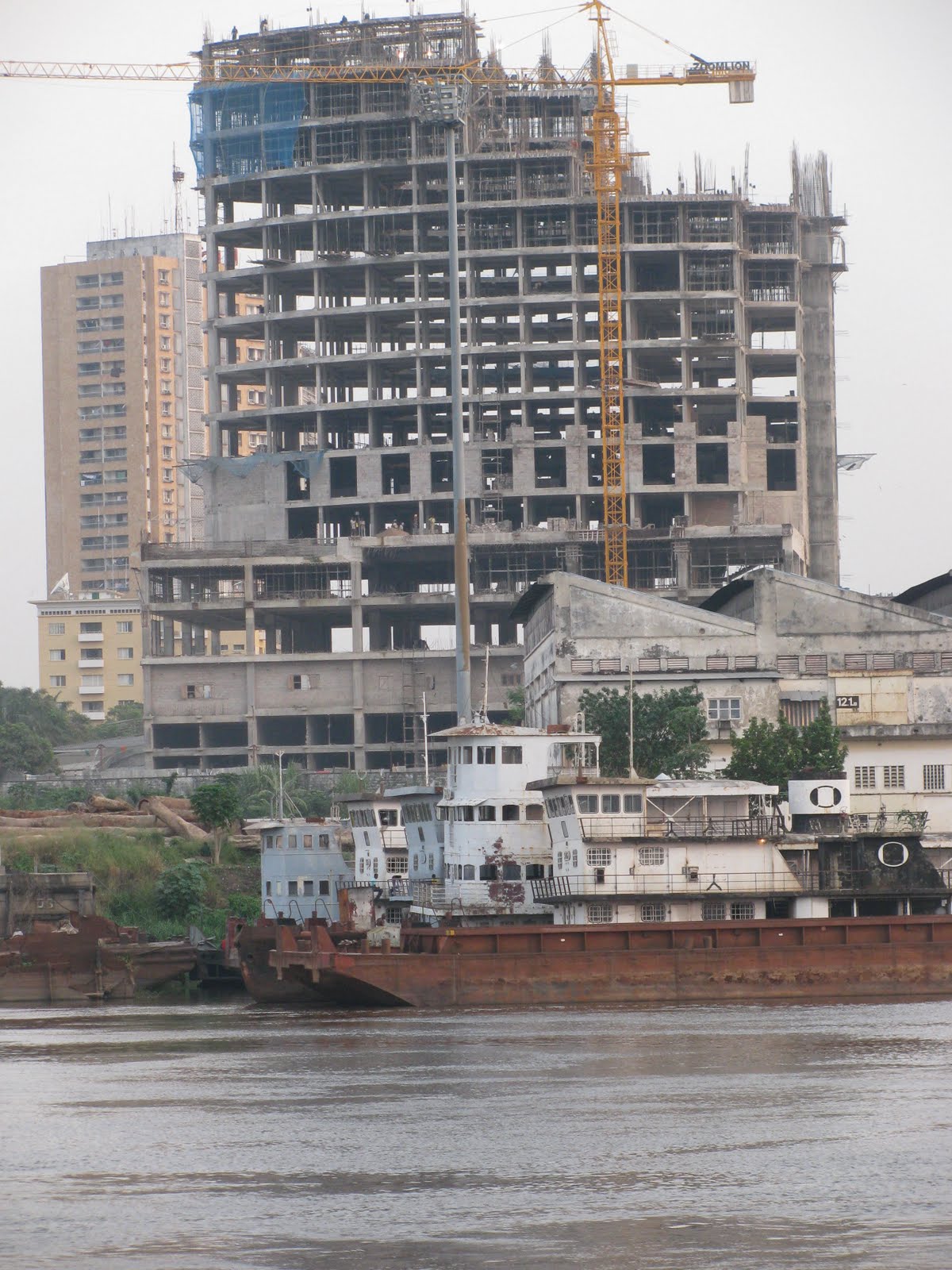
On the corner opposite the old Stanley Hotel, later Musée de la Vie Indigène and now Gallerie du Fleuve (See Feb. 20, 2011), is another construction fence with the concrete shell of a 22 story building towering above it, the Congo Trade Center.  When I left Kinshasa in 2006, the building on the corner housed GTS Express (a freight forwarder) and Ets. De Cock, which had bought the Travhydro group in 1987, including the adjacent lot on Ave. Wagenia (ex-Hauzeur).  Originally, the building was the G.B. Ollivant store, part of the Lever Brothers group, which in Congo included Marsavco and SEDEC.  The web informs that “Ollivants” was the place to buy your pith helmet and silk shirts.
GTS and Ets. De Cock - 2004

Congo Trade Center under construction 2011 - Galleries Presidentielles behind (L)

The Congo Trade Center is being built by Modern Construction with South Asian capital.  When complete, it will include a 240-room hotel, a shopping mall, grocery, six restaurants, a casino, bar and nightclub.  Modern Construction is also planning or has under construction: Modern Plaza (a 5-Star hotel), Modern Bella Casa and Modern Paradise.
Artist's view of the Congo Trade Center

Gare Centrale - urban rail is coming

Gare Centrale.  The creation of the Place du 30 Juin in front of the Gare is a master stroke.  It anchors the expanded Boulevard du 30 Juin and provides public space of a kind which is rare in Kinshasa.  It has become a popular place for Congolese stroll, congregate and take pictures.  High rise buildings are going up around the square, which should increase street-life here.


Place du 30 Juin - Gare Centrale

Tuesday, June 28, 2011

Leopoldville 1940s - Restaurant Scene Develops

Kinshasa enjoys the best of both worlds as far as Congolese and continental cuisine is concerned.  Historically, the standard was Belgian and European fare (Kin serves, quite possibly, the best frites (French fries) in Africa), but upscale restaurants featuring the impressive range of Congolese specialties are increasingly found throughout the city.  A resident international community and Congolese exposed through travel or the diaspora also support a variety of international ethnic cuisines.  A perusal of contemporary restaurants in Kinshasa underscores this diversity (http://www.pagewebcongo.com/).

The Hardy Bar - early 1950s

The original building in the 1920s

Hardy Bar – This establishment, on a prime location on the Place de la Poste, dates from the 1920s when the eponymous first post office was built in Kinshasa (See February 20, 2011).  Early on it served both thirsty patrons and their vehicles, with gas pumps set up on the curb.  During WWII, the proprietor, Righini, a national from an Axis country, turned the place over to Arthur Hardy, who renamed it Bar Hardy (See May 23, 2011).  This management maintained until the late 1950s, when the café was renamed “Café Rubbens”, after the street running along the south side of the building.  In the late 1950s, this was the only place serving ice cream in Leopoldville.  In 2005, the Belgian Centre Wallonie de Bruxelles renovated the structure as the premises of its cultural center.


"Le Rubbens" around 1958 (Cinquantenaire Building, now Belgian Embassy completed)

"Le Rubbens" at night
Au Glacier -- Down the street from the Hardy Bar, was “Au Glacier”, a patisserie-confiserie opened by Hoste Mestrez in 1947.  This is now the location of Ibiza Bar, one of the hottest clubs downtown.  Until the Galleries Presidentiels squatted on and cut off Avenue Rubbens (now Ave. Nation), this was a pleasant street linking the Place de la Poste with Place Braconnier.  “Au Glacier” was in the former Cominex store (See Mar. 24, 2011) and the balconied building next to it is now the Caf’Conc restaurant.


Ave. de la Nation - Ibiza Bar on right.
Sidewalk Café Scene -- In the pre-Independence period and after, sidewalk cafes along the Boulevard were quite popular, allowing patrons to take advantage of the cool of the evening.  The three-block section from the Regina to Ave. Beernaert featured several including one opposite the Regina at the Diacomichalis building, the Pizzeria, Café de la Paix (where the Relais is today).
Sidewalk cafe at Hotel Le Regina on Boulevard Albert 1er


Garage Nogueira, Blvd. Albert 1er - left of VW (R)

Le Pergola – A personal favorite was the Pergola on the corner of Ave. Boulevard Albert 1er (30e Juin) (See Mar. 19, 2011).  This restaurant, managed by Italians, took over the Nogueira Garage in the late 1950s and featured both an air conditioned in-door dining room as well as an outdoor arbor-garden, the “pergola”.  The Capitaine Tartar was excellent.  In the early 1970s, the site was cleared to make way for the Banque Commerciale Zairoise (now BCDC).


"Le Pergola" just above the lead scout car

Le Mandarin.  The Mandarin Restaurant opened June 30, 1971 on the 7th floor of the new Institut National de Sécurité Sociale building on Boulevard 30e Juin near the Golf Course.  Marcel Lambrichs, who also designed the Belgian Embassy on Place Braconnnier, was the archiect.  Prior to Mobutu’s celebrated opening to the People’s Republic in 1973, the Chinese were represented in Congo by the Republic of China (Taiwan) and built the pagoda at Nsele.
INSS Building with Le Mandarin Restaurant on the top floor

Restaurant Galiema foreground - Hotel Intercontinental upper left
Restaurant Galiema -- This restaurant occupied a prime location on the promontory overlooking Ngaliema Bay and the rapids downstream (See Feb. 20, 2011).  It remained a popular venue after Independence, until it became the Officers’ Mess of the FAZ in the 1980s and is now part of the Presidential compound.


Restaurant Galiema - Dining Room

Galiema - The Bar

La Devinière -- In the late-1950s, this restaurant on the slopes of the Binza hills was a ways out of town on the road to Matadi, but offered spectacular views of the city and the Congo River rapids.   It appears to have had links with Storey-Day’s Le Regina downtown.  In recent times, the La Devinière property was taken over by a private school, but its proximity to the Presidential Compound (Palais de Marbre) in Binza precludes taking pictures, and not much can be seen behind the perimeter wall.


La Deviniere - outside terrace
La Deviniere - The dining room

La Deviniere at night
Congolese Restaurants – Congolese did not have a culture of going to restaurants and racial segregation would have prevented them from patronizing the European restaurants described above until just before Independence.  Nonetheless, the first restaurants serving Congolese opened in 1942, managed by Angolans.  In November 1948, a restaurant for Congolese opened in the Marché.  Two years later, the restaurant “Vert” opened in the cité, followed by Lutete’s in 1954.  Today, popular restaurants featuring Congolese cuisine in Gombe include, Inzia, La Chaumière, Super Aubaine.