TRANSLATE

Friday, April 30, 2021

Kinshasa 2021 - Sims Chapel Replica in Kwilu Province

Five years ago, I wrote about Sims Chapel in Kinshasa (May 4, 2016). Built in 1891 by Dr. Aaron Sims of the American Baptist Missionary Union, it is the oldest permanent building in the city and still serves a regular congregation.  Recently, I learned of a new church under construction about 250 kilometers east of Kinshasa at Kinkosi in Kwilu Province that is a reproduction of Sims Chapel.
Sims Chapel in Kinshasa

Kinkosi is a parish in the church district of Kikongo, part of the Communauté Baptiste du Congo (CBCO). CBCO is a member of the Eglise du Christ au Congo, which federates all the Protestant denominations in the country. In the early 1920s, residents of Kinkosi learned of Baptist missionaries at Sona Bata near Kinshasa who were preaching, teaching and healing. The villagers thought these services could benefit them and two young men hiked west for ten days to Sona Bata to ask the American Baptist missionary to send a pastor to their village. It was not until 1926 that a Congolese pastor was available to come to Kinkosi, but the response of the villagers was such that the mission decided to open work in the region and in 1929, Kikongo station was established on the Wamba River (Strong Eyes of Faith).
Aerial view of Kikongo and Wamba River

Kikongo and Sona Bata circled in red.

As the centenary period of the Kinkosi church’s founding approached, the congregation reached out to missionary Glen Chapman, who with his spouse Rita, has served at Kikongo since 1992. Glen suggested a commemoration with a historic church that was representative of CBCO, and they agreed to use Sims Chapel as the model. He was able to secure financing from the Emmert Legacy fund and brokered a construction contract between the village and two builders who had successfully completed buildings and other infrastructure for the Université Baptiste du Congo at Kikongo.
A community meeting at Kinkosi

Kinkosi church - the rafters are up.

Installation of the tin roof.

The roof is on.

While researching this post, I discovered that Kinkosi may not be the first instance of replicating Sims Chapel. In 1900, a new chapel was erected at the Baptist post of Kifwa, a predecessor location of the Sona Bata station, which was established on the rail line in 1907. The choice was more likely practical than symbolic, as Dr. Sims’ chapel had proved to be a design that Congolese without extensive construction background could produce. The brick and thatch roofed structure was 24’ x 50’ (7 x 15 meters) vs 20’ x 60’ (6 x 18 meters) for Sims Chapel.
(Baptist Missionary Magazine, 1900)


Sims Chapel in 1897 (Baptist Missionary Magazine, 1897)

The church roof was completed in March 2021 and the Rector of the Université Baptiste du Congo is planning its dedication.

  • Kinkosi photos courtesy of Glen Chapman.

Thursday, April 15, 2021

Leopoldville 1926 – Hotel Sica – The Mystery of the Memling

In 2011, I posted a piece about the Hotel Memling, its origins as the Hotel SICA and after 1937, a property of Belgian Airlines Sabena (Mar. 29, 2011). Recently, a colleague shared an early photo of the Hotel SICA which sent me back to research. The complex in the picture clearly reads “Hotel SICA” on the gables of the annexes in the foreground, but the main building in the background doesn’t match the SICA. My friend’s photo looked more like the Hotel Metropole of the 1920s. Was there a connection? I believe I’ve solved the mystery by consulting documentation at hand and conjecture from the evidence portrayed in images.
The photograph of the Hotel SICA.
The Hotel Metropole in the 1920s

A related issue was Belgian Airline Sabena’s claim to have created the Hotel Memling in 1937, although that name did not appear in print until after 1952. In my original post, I hinted, admittedly obliquely in retrospect, that Sabena based its claim to the Memling on the Sabena Guest House (near Ndolo Airport on Ave Kabasele Tshamala), both of which were subsumed by the Compagnie des Grands Hotels Africains in 1959.

The Sabena Guest House - the car dates this image from the 1930s (author coll.).

As described in the earlier post, the original building where the Memling stands today was built by the Société industrielle et commerciale de l'Afrique occidentale (SICAO) around 1920, but which went bankrupt in 1924. Two years later, the Société Immobilière, Commerciale et Agricole (SICA), was created by Louis Promontorio. An early colonial figure, Promontorio worked for the Compagnie du Kasai and the Dutch House (NAHV), then opened his own firm in Leopoldville (Kintambo) in 1912. In 1924, he floated the Cie Urbaine des Transports en Commun du Stanley Pool. Promontorio put up a controlling interest of 128 of 200 500 franc shares in the new company, but it seems Leopoldville was not yet ready for public transit (Oct. 24, 2011).

The SICAO Building under construction around 1919 (author coll.).

When SICA was founded in November 1926, Promontorio was granted 850 of 2500 Fr.1000 shares on the basis of a 0.44-hectare property (about an acre) in Kinshasa. He also received 1250 “Founder” shares, which gave him a majority of votes in the new company. Another, non-capitalized asset but referenced in the founding documents, was a contract with option to buy on a 50-hectare parcel at Kingabwa (part of contemporary Commune de Limete), upstream from Kinshasa. Following the designation of the Board of Directors, the company established its Congo headquarters at the Hotel de la SICA. This suggests that the hotel was in operation prior to SICA’s formation, most likely this was the SICAO property Promontorio contributed as in-kind capital.

The Hotel SICA around 1940 (liberas).

The Hotel Metropole was operated in the 1920s by Felix Mertens, the same time as the SICA. A period photo shows a two-story building about the same size as the SICA, but with freshly-painted stucco walls rather than exposed brick and arched windows instead of square enclosing the second-floor balcony. The Metropole appears to have had a short run before succumbing to the Depression. The earliest references I’ve found date from 1924-25. In 1926, a cook at the hotel, D. Bandago, was diagnosed with tuberculosis by the local health service. The hotel-restaurant was recorded in Congo Revue 1927 and in 1928 it was listed as a destination for a taxi service from the Garage Mayo on the Place de la Poste (Mar.24, 2020). But by the beginning of the 1930s, the Hotel Metropole disappeared from the Leopoldville hotel scene.

The Hotel Metropole in the 1920s (author coll.).

The photo showing the Metropole with “Hotel Sica” on the annex gables suggests the Metropole was taken over by the SICA. The photo of the Metropole above shows a building in the background which is obviously the SICA. This would place the Metropole at the corner of Ave. Stanley and Ave Bangala where the Residence Atlantic is today.

This acquisition of the Metropole by SICA is corroborated by photos in the Henri Guillaume collection at the Liberaal Archives in Ghent (liberas). Guillaume went to Congo in 1939 to work for the SICA. His photos show a variety of perspectives of the two buildings, including the annexes between the two hotels which housed European staff, and where Guillaume had an apartment. At the end of 1928, SICA’s balance sheet showed real estate valued at Fr.4.2 million, up from Fr.1.9 million the year before, suggesting acquisition of the Metropole.

Henri Guillaume on the grounds of the annexes around 1939 (liberas).

Guillaume outside the Metropole with Hotel SICA in background (liberas).

But what of Sabena’s claim that it built the Memling in 1937 (Hotel Memling)? First, Guillaume’s photos show that the two original hotel complexes were still extant in 1939. Second, there is nothing in the SICA’s annual reports from 1936 to 1958 that indicate Sabena had any investment in the property. Finally, the first multi-story wing of the SICA along Ave. Stanley must have been built in the early 1950s, when SICA decided to focus on its real estate activities in Kalina, Kingabwa and near the port. The first images specifically naming the Memling date from 1952, in a tourist brochure produced in Brussels.

Some of Leopoldville's hotels in 1952 (author coll.)

The Hotel Memling (R) incorporating the original SICA building (author coll.)

Another compelling indicator comes from Tom Marvel, US Press Attaché in Leopoldville during the war who returned to Congo in late 1945, and reported that he, “saw a friend at the Sica, then had lunch at Sabena, and met the four o'clock Fima (ferry) from Brazza.” In Sabena’s annual report for 1945, the company claimed revenues of Fr.3.7 million from operation of its guest-houses. Similarly, in 1949 the Sabena Revue, the airline’s magazine published a full-page advertisement for the Hotel Regina, the Storey-Day property around the corner on Blvd. Albert (Mar. 29, 2011). The ad promoted the Regina’s services for transportation and reservations upon arrival at Ndolo airport, and the amenities of its “Hôtel de Premier Ordre” – a renowned restaurant, bar, grill-room, patisserie and a catering service. No mention was made of the SICA or the Memling in the magazine. If Sabena was operating a major hotel downtown, or planning a major expansion, it would have received some coverage. Instead, the magazine touted the establishment of Sabena Guest Houses around the country.

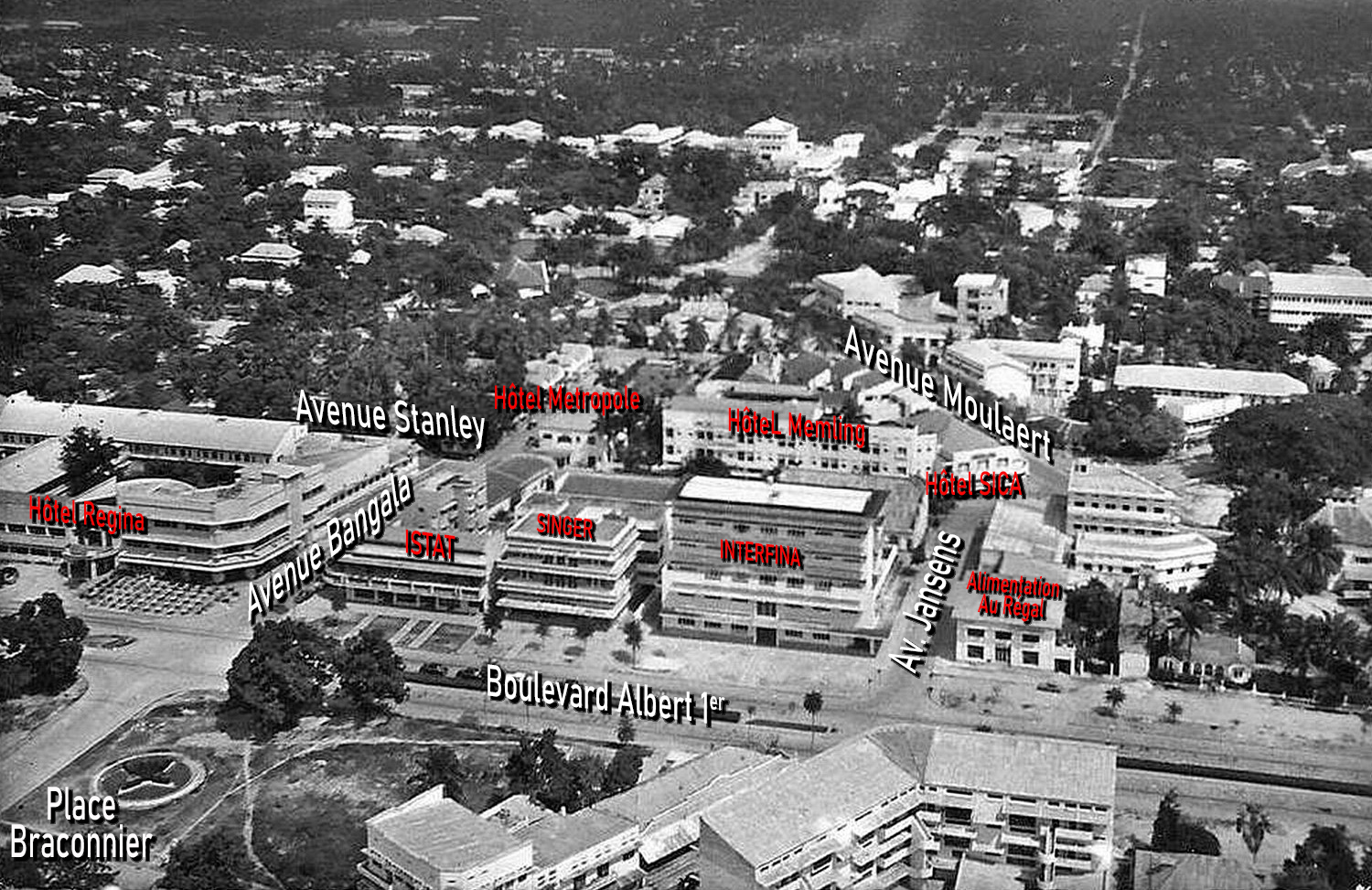
This photo from the mid-1950s shows the SICA complex along Ave. Stanley.
(Thanks to my colleague for labelling)

Absent any conclusive link of Sabena to the SICA in 1937, my initial conclusion stands, that the airline’s claim to the Memling is based on the 1959 merger which brought the SICA property and the Sabena Guest House at Ndolo under the same corporate framework. Certainly, the Art Deco architecture of the Guest House suggests its construction in the 1930s (Jan. 4, 2018).

A view of the Sabena Guest House in the 1950s (author coll).

A significant restructuring of SICA took place after World War II. Louis Promontorio had died and his place on the Board taken by his son, Victor. Victor was born to a Congolese mother in Kintambo in 1912. When she died in 1919, Promontorio took him to Belgium. There he graduated with a law degree from the University of Louvain in 1935, making him among the first Congolese to obtain a university degree. In 1960, he participated in the Round Table meeting in Brussels that led to Independence, and was elected Senator from Equateur Province in the first Parliament in June that year. Promontorio (Seya Tshibangu under Mobutu’s Authenticité) became the first Congolese attorney admitted to the Leopoldville bar in 1963. 

In November 1946, Victor resigned from the SICA board, and was replaced by Robert Cousin, representing the Société Mobilière et Imobilière Hosa (which provided much of the funds for the capital increase in 1948). Armand Regnier, Administrator and longtime Secretary General of the firm, resigned as well and was succeeded by Louis Lambelin, who became the Managing Director. Another board member, Hoebrechts, was replaced by Count Jean de Broqueville. The following year, Promontorio and his stepmother, ceded 8.8 hectares in Ndolo to the company. The firm nearly doubled its capital from 7.4 million francs to 13.4 million. In September 1948 capital was raised to Fr.40 million. That year, the value of land, buildings, material and furnishings was reported at Fr.13 million. In 1950 these assets had increased to Fr. 15.5 million, of which Fr.9.6 million was buildings. The following year, the value of buildings rose to nearly Fr. 20 million. This suggests that Wing A was completed in 1951 (rather than 1937) and it follows that the hotel began to be referred to as the “Memling” after 1952 (though why a 15th Century Flemish painter inspired SICA’s board is unclear). Notably, guidebooks and the company’s own letterhead continued to show the Memling as “Propriétaire Société SICA”.

Letterhead showing ownership by SICA (author coll.)

Construction of the new three-story wing on Ave. Stanley required the demolition of the Metropole annexes. At the same time, the terrace of original SICA building along Ave. Moulaert was enclosed and the facade remodeled to tie in with the new structure. The main building of the former Hotel Metropole was demolished before Independence in 1960 and an office-residential building, the Residence Atlantic, was built.

The modified SICA building (foreground) and the new "Memling" wing (author coll.)

An interior view of the new wing (author coll.)

In 1955 the original SICA building was demolished and replaced with “Wing B”, an eight-story structure that angled from Ave. Stanley down Ave. Moulaert (Ave. Tchad), adding another 75 rooms, for a total of 114.

Construction of "Wing B" along Ave Moulaert. Note Otraco Building construction upper right.
(author coll.)
Hotel Memling late 1950s. Note construction of Residence Atlantic at far end of Wing A (author coll).

Hotel Memling 1961, note completed Residence Atlantic (Northwestern University, Foreman Coll.)

After Congo’s Independence June 30, 1960, the Memling became a primary center of political activity, inasmuch as it housed much of the foreign press and was located opposite the Hotel Stanley, where the United Nations established its initial headquarters (June 3, 2015). Competing political factions held press conferences or organized demonstrations in the street outside. In 1963-64, Wing C was built in the same architectural style as Wing B, extending down Ave Moulaert, bringing the total number of rooms to 174.

The Memling shortly after completion of "Wing C" in mid-1960s (author coll).

The Sabena Guest House was later acquired by Boniface Zoao, the last Bourgmestre (Mayor) of Kinshasa, who was replaced by a military governor in 1966. One of his relatives manages the property today and is slowly upgrading the buildings and grounds hoping to attract substantial clientele again.

The former Sabena Guest House in 2017 (author coll.)
The restaurant of the Guest House (author coll.)
Note the wing motif over the garage (author coll.)

In 1985, the Memling's “Wing A” was demolished in a major renovation of the property. Eighty four years after Sabena’s alleged construction of the Memling, or 70 years after the construction of “Wing A” in 1951, perhaps it doesn’t matter much who built what when. The Memling remains both a historic and significant contemporary fixture in downtown Kinshasa.
Interior view of the Memling of the wing replacing "Wing A" (trip advisor)


Sources
  • Bulletin Officielle du Congo Belge (multiple years) 
  • Congo: Revue générale de la colonie belge, 1927, Vol.8, No.1. 
  • Liberas – Centrum voor de Geschiedenis van het vrije denken en handelen (liberas.eu)

Tuesday, November 3, 2020

Leopoldville 1960 – Patrice Lumumba’s Residence

This photograph, taken of a villa on Boulevard Albert 1er across from the Leopoldville golf course in May 1948, was Patrice Lumumba’s residence in 1960 when he became Prime Minister of the independent Republic of the Congo.  Lumumba was allocated the house by virtue of his nomination in February 1960 to the College Exécutif, a six-member advisory committee of Congolese representatives to the Governor General.  Otherwise, even this late in the colonial period, an African could never have purchased a house in the European city. Lumumba was tapped to represent Kasai Province, though he had lived in Leopoldville since September 1957 (Jan. 17, 2016).
The villa on Blvd. Albert 1er, May 1948 (author coll.) 

Family photo in the garden. (Published in Jet Magazine, March 9, 1961)
After the Elections in May, Lumumba was designated to form the first government. Kasa-Vubu, representing the important Bakongo community in the capital (Jan. 13, 2019), threatened to boycott and a compromise was reached whereby Kasa-Vubu would be elected President by the Parliament. Jean Van Lierde, a friend and advisor to Lumumba, recalled waiting at the house on the Boulevard on June 23 for Kasa-Vubu’s three ABAKO nominees for the Premier’s expansive cabinet. Following the Independence festivities and transfer of sovereignty to the new nation, President Kasa-Vubu moved into the former Provincial Governor’s mansion on Mont Stanley (Jan. 28, 2019), while Lumumba had to wait until July 5 for Governor General Henri Cornelis to vacate the Governor General’s residence on Ave. Tilkens (Ave du Fleuve) (Sep. 12, 2011).  By this time, General Janssens’ neo-colonialist position had precipitated an army mutiny and plunged the new nation into the Cold War.
Lumumba gives a press conference in the residence, June 2, 1960 (author coll.)
Belgian actions to safeguard its citizens by militarily occupying key cities and airports provoked Kasa-Vubu and Lumumba to break relations with Belgium on July 14. Lumumba announced the country would call for Soviet support if Belgium did not withdraw. Meanwhile, the United Nations responded decisively to a separate request to send a peace-keeping force to the new country. Relations with the UN soured in August when the international body appeared to acquiesce to the secession of Katanga Province. Furthermore, relations between President Kasa-Vubu and Lumumba became strained as the Prime Minister expressed increasingly strident anti-imperialist positions while the President appeared influenced by strong messages from western Ambassadors.  Both Brussels and Washington approved plans to remove Lumumba. The conflict came to a head on September 5 when Kasa-Vubu went on Radio Leopoldville to dismiss Lumumba.  Shortly afterwards, Lumumba came on the radio dismissing the President. The following day, Kasa-Vubu’s Prime Minister designate, Joseph Ileo, issued a warrant for Lumumba’s arrest. The United Nations closed the radio and all airports in the country.
Ghanaian soldier at the radio station September 5, 1960 (author coll.)
According to the Loi Fondamentale, the constitutional framework drafted by the Belgians, Kasa-Vubu was in his rights as President. But Lumumba cried foul and secured a vote in his favor in both Houses of the National Assembly on September 8, and called upon the UN to reopen the radio and airports. The UN placed guards at Parliament, the President and Prime Minister’s residences. In the afternoon of September 11, a National Army (ANC) unit arrested Lumumba at his residence on Blvd. Albert, executing Ileo’s warrant.  He was taken to Camp Leopold II (now Kokolo), but released after two hours. The Premier toured the cité rallying his supporters, then drove to the radio station three blocks from his home.  A Ghanaian guard detail refused him access.  At that point, Lumumba decamped from the Prime Minister’s residence for his private one.  Mme. Lumumba was seen leaving the residence in a vehicle filled with the family’s luggage.
Ghanaian troops at the Prime Minister's Office. Lumumba on the balcony (arrow)
(author coll.)

Ghana troops reinforce positions at the radio station, September 1960 (author coll.)
Tensions remained high in the city, with neither side conceding and the UN’s stated position of neutrality appearing to favor the Kasa-Vubu faction. Ghanaian troops withdrew from the Radio station on September 13 when the new Minister of Information in the Ileo government arrived to take possession.  The following day, Colonel Mobutu announced on the radio he was neutralizing both factions until the end of the year – a coup d’état.  He created an interim government of technocrats -- the College of Commissioners -- comprised of the cream of Congo's few university graduates.

Mobutu kept up the pressure.  On September 15, he announced the expulsion of Soviet and Czech embassies for distributing pro-Lumumba propaganda.  The next day, his troops arrested staff at the Prime Minister's residence and those at the administrative office on the street behind the Residence.  Lumumba left his private home and went into hiding, but on Sunday, September 18, returned to the official residence on the Congo River.  Ghanaian troops ensured his safety and screened journalists to an impromptu press conference.

Lumumba left the official residence several times over the next three weeks to rally supporters, but always returned to the safety of the Ghana guard detail.  The College of Commissioners fulminated about this, calling for an ANC guard at the Residence, for the electricity and water to be cut off, and for Mobutu to execute the arrest warrant.  Finally on October 12, Mobutu acted, deploying Congolese soldiers in an outer ring around the Ghanaians.  He reached an agreement with the UN that Lumumba would only be arrested if he left the Residence.
Ghanaian troops secure the perimeter of Lumumba's private residence (author coll.)

Col. Mobutu attempts to arrest Lumumba on October 11, 1960. The Ghanaian guard refused. 
(Author coll.)
On the night of November 27, in pouring rain, Lumumba slipped out of his residence, hidden on the floor of the back seat of his Chevrolet station wagon under the legs of the house workers.  Driving the workers home at night was a normal occurrence and the UN detail barely gave to car a look.  The ANC questioned the driver, who said he was also going to buy cigarettes, and would bring them back a carton, and they let him pass.  Lumumba rendezvoused with a number of supporters (including Pauline and son Roland, who had moved into the cité), and in a three-vehicle convoy set out for Stanleyville (Kisangani), 2000 kilometers to the northeast, where Lumumbists under Antoine Gizenga held power.  On December 1, Lumumba and his party were apprehended by Congolese security services near Mweka in Kasai Province.  His return to Leopoldville and subsequent transfer to and murder in Katanga is beyond the scope of this post, but can be consulted in detail in Ludo De Witte’s The Assassination of Lumumba (2001).
Lumumba in his car before confinement (The Africa Report, Sept. 18, 2020)

During years the family was in exile, Lumumba’s younger brother Louis was an influential player, elected as Governor of Sankuru Province in 1963 and named to the Board of Air Congo in 1968.  In 1971, however, he was accused of illegal diamond dealing.  The family retained possession of the house on the Boulevard, even while the children now and then appeared as members of the opposition to Mobutu in the diaspora. With Mobutu’s overthrow in May 1997 and Laurent Kabila’s advent as President, daughter Juliana Lumumba returned to Kinshasa as Minister of Culture and Arts in Kabila’s government.
The Lumumba residence in 2006 (author coll.)
In June 2013, the Matata Ponyo government released an RFP to rehabilitate the Lumumba residence and construct an annex for Mama Pauline Opango Lumumba.   Additional RFPs were issued following year in April and May, for further restoration of the residence and to build a guard house and upgrade the security wall around the property.  Pauline Opango Lumumba died in December 2014 and the family held a wake at the residence. Ownership of the property passed to Lumumba’s son, Roland.

Pauline Opango Lumumba's wake (Radio Okapi, Aug. 28, 2017)
In December 2018, “African Challenges” published an article by a Kinshasa correspondent arguing the house should become a museum. It cited the only “unique” historical relic was a white Ford Maverick up on blocks in the rear of the property.  Why, the author asked, wasn’t the state doing more to preserve such important artifacts of this National Hero?  The question of museum status (and public support) for the Lumumba residence, as well as that of Kasa-Vubu on Ave. Kasa-Vubu, are important issues for the country to address 60 years on, but the Maverick (which could be seen in the carport in 2006) was not the getaway car.  The Chevrolet station wagon has consistently been cited as the vehicle.  Ford did not introduce the Maverick until 1970.  
The Maverick on blocks outside the carport (African Challenges, Dec. 22, 2018)

A view of the Maverick in 2006 (author coll.)
The Lumumba residence occupies a prominent, easily accessible, location in Kinshasa and could be repurposed as a museum if the family agreed. As a tourist attraction for both national and foreign visitors, it has huge potential to tell Lumumba’s and the country’s story.

Sources:
  • African Challenges, Dec. 22, 2018. “Devoir de mémoire: ce qui reste du héros national Patrice Lumumba à Kinshasa” https://www.africanchallenges.com/devoir-de-memoire-ce-qui-reste-du-heros-national-patrice-lumumba-a-kinshasa/
  • De Witte, Ludo, 2001. The Assassination of Lumumba, Verso.
  • Radio Okapi, Dec. 12, 2014. https://www.radiookapi.net/actualite/2014/12/29/pauline-opango-la-veuve-de-patrice-lumumba-inhumee-kinshasa

Monday, July 13, 2020

Leopoldville 1918 – “La Grippe Espagnole”

I recently heard a piece on U.S. National Public Radio about Brian Melican's article in the New Statesman entitled, “A tale of three cities: the places transformed by pandemics across history(Melican, Apr. 20, 2020). His research examined the plague in Marseille in 1720, cholera in Hamburg in 1892, and Spanish Influenza in Ostersund, Sweden in 1918.  In this time of Covid-19, I wondered how Kinshasa fared during the Spanish Flu, or “Grippe Espagnole”, epidemic in November 1918.
Kinshasa circa 1918 - the central business district (now Ave. de la Nation)
Leopoldville, and Kinshasa, (the two were separate and distinct polities at this time), were coming out of four years of world war, which had negatively impacted the economy.  In fact, the outbreak reached Stanley Pool the day after word of the Armistice in Europe.   Although Congolese Force Publique troops had defeated the Germans in their colonies of Kamerun in 1914 (Aug. 3, 2014) and Tanganika in 1916, the War continued to be a significant burden for the Congo. German submarine activity in the South Atlantic had curtailed imports, and more importantly, suppressed exports upon which the colonial economy depended.
Kinshasa in 1919
In mid-November 1918, the first cases of Spanish Flu were reported in Leopoldville.  While the contagion is acknowledged to have come from ships originating in Europe calling at the port cities of Boma and Matadi, the virus was simultaneously spreading to up-river communities in the east of the colony, particularly from the mining cities of Katanga, which were infected via the railroad from South Africa.  As early as October 16, 1918, the Vice Governor General of Katanga issued an Ordonnance providing measures to take to contain the “Spanish Influenza” virus.
The public market in Kinshasa, located opposite the current Poste Centrale on Blvd du 30 Juin.  
Note railway line to Leopoldville in upper left provided the right-of-way for the future Boulevard.

The virus quickly spread in Kinshasa, then Leopoldville and across the river to Brazzaville.  In its centenary history, the Catholic church recorded that 250 Congolese died in Kinshasa, 150 in Kintambo (Leopoldville) and 500 in Brazzaville.  Catholic missionaries could only provide hot water as treatment for victims.  The British Baptist Missionary Society (BMS) reported that hundreds died, 3000 fled back to their home villages, spreading the contagion.  The Congolese population of Leopoldville was estimated about 5,000 at this time.
The port at Kinshasa
The American Baptist mission in Kintambo saw students in its preparatory primary school scattered by the influenza in November, although classes did resume by January. Dr. Catherine Mabie, writing about the impact on the mission’s  hinterland around Leopoldville noted:

“Spanish influenza found its way into the river and despite all quarantine regulations has spread like August grass fires over the entire country.  The hungry, ill-nourished native fell easy prey to its ravages. Many villages have been decimated.  Some have lost more heavily even to a fifth or fourth of their population. Station day and boarding schools have been closed and pupils returned to their towns, but January finds the plague well-nigh spent and schools reassembling”.

By the beginning of 1919, the epidemic had reached Stanleyville from the Katanga while the strain originating in Leopoldville had infected Congo River communities as far upstream as Bumba, 250 kilometers downstream from Stanleyville.
The original hospital for Congolese in Leopoldville.  Now known as l'Hôpital du Rive.
The government imposed strict limitations on travel and transportation between cities and rural areas. Shipping on the river was suspended for three weeks.  This had a knock-on effect on other economic activity and the food supply chain for Congolese workers in the city failed. Only direct intervention by local authorities prevented famine.  Schools closed.  Death among prison inmates was particularly high. Medical facilities were rudimentary. The only hospital serving Congolese was located in Leopoldville on a site just above the rapids (now known as l'Hôpital du Rive, above), and its 100-bed capacity was stretched to more than 300. In addition, a small dispensary was located in Kinshasa (Nov. 26, 2012).
Quarantine facilities for tuberculosis patients
In a letter to the Tribune Congolaise in April 1919 after epidemic had subsided, a Kinshasa resident reported there were:

“Very few deaths among the white population.  The scourge found a well-prepared fertile ground among the native population where death does its massive harvest; shall we ever know how many of these poor misérables died of this epidemic. The situation was already precarious in the light of the fact that famine was threatening certain regions like Middle Congo and Lower-Congo and Mayumbe.  Many Blacks died from these regions because, being underfed, they could not put up any resistance again: death!  They could be seen collapsing in the streets and dying at the very spots where they fell after long hours and hours of agony”. 
(Tribune Congolaise, April 17, 1919, cited in Sabakinu, 1984, translation in the original)
 Kinshasa cité, possibly Ndolo (Barumbu), note river on horizon.
In its annual presentation to the Belgian Chamber of Deputies in 1919, the Ministry of Colonies focused on the economic consequences of the epidemic -- citing nearly 3,000 tons of exports idled up river from the port at Kinshasa out of an annual shipment of 30,000 tons. The Chamber was also apprised that the expected shortfall in tax revenues in 1919 was also due to the pandemic. The report acknowledged that it was impossible to determine how many Congolese died across the colony because the Ministry only reported cases specifically treated in its medical facilities, which were primarily located in the European towns. However, 60% of those treated were flu cases, of which 4.8 % died, and the Ministry estimated that hundreds of thousands of Congolese perished.  Out of an estimated six million people in the colony, the death toll from the epidemic would be upwards of 300,000.  The New York Times, reporting from Brussels on April 24, 1919, cited estimates of as many as 500,000 deaths among Congolese.
Another view of the Kinshasa cité.
The colonial government public health system was already coping with on-going epidemics of sleeping sickness, infantile paralysis, cholera, small pox as well as influenza. Sleeping sickness was a major challenge, because it devastated the Congolese workforce necessary to keep the colonial economic machine going. The colonial health service had an extensive monitoring system in place, checking arrivals on river boats, and imposing quarantine.  By February 1919, the epidemic had eased in Kinshasa and Leopoldville.
Quarantine camp for Small Pox victims.
The influenza pandemic was transformational for Congolese urban dwellers. As the author of the report to the Chamber in 1918 observed, the higher salaries offered in cities did not compensate for inadequate housing, insufficient and mediocre food, exposure to accidents and risk of disease.  Belgian labor policy considered the Congolese to be lazy and therefore formal work was seen as a moral obligation and contributing to the colonial civilizing mission.  The virulent flu epidemic reinforced these apprehensions among Congolese, and the author argued, labor policy must increasingly be responsive to self-interest rather than relying on compulsion.
Another view of the Kinshasa business district (Now Ave. Isiro).

Sources:
  • American Baptist Foreign Mission Society, 1919. Annual Report.
  • Baptist Missionary Society, 1919, Annual Report.
  • Belgium, Chambre des Représentants, « Rapport annuel sur l’activité de la colonie du Congo Belge présenté aux chambres législatives », 1918 & 1919
  • Cornet, René-Jules, 1971. Bwana Munganga, Academie Royale des Sciences d’Outremer.
  • L'Eglise Catholique au Zaire: un siècle de croissance (1880-1980), 1979. Edition du secrétariat de l’épiscopat. 
  • Sabakinu Kivilu, 1984. “Population and Health in Zaire during the Colonial Period from the End of the 19th Century to 1960”, Transafrican Journal of History, Vol. 13, pp. 92-109.